
Morgan County Court Records After a Jail Arrest
A Morgan County arrest normally starts with Morgan County Sheriff's Office or another law-enforcement agency. Morgan does not operate a long-term county jail, so the person may be handled locally for processing, holding, or transport before being booked at Weber County Correctional Facility or, when directed, Davis County Jail. Weber procedures matter because the Weber jail houses Morgan inmates under the county agreement and schedules inmates for arraignment on the next court day.
The custody side and court side should be read separately. For current custody, booking-date, and roster charge labels, use jail inmate records. For booking-photo availability, use jail mugshots. The court record is the Morgan Justice Court or Second District Court case showing prosecutor-filed charges, later amendments, hearings, pleas, warrants, dispositions, fines, and sentencing. A roster charge after arrest is useful context, but it is not a conviction and may not match the filed court charge.
Arrest, Booking, and Court Filing Path
The local sequence has several handoffs. First, an arrest is made in Morgan County. Second, Morgan handles immediate local needs such as reports, temporary holding, transport, or court movement. Third, the arrestee may be booked at Weber County Correctional Facility, or may be sent to Davis County Jail depending on the housing decision. Fourth, the housing jail may show a roster entry. Fifth, Weber's booking process says inmates are scheduled for arraignment on the next court day. Sixth, the Morgan County Attorney's Office reviews reports and files, amends, or declines charges. Seventh, the filed case appears in Morgan County Justice Court or Second District Court.
That timeline explains why court records after a jail arrest can lag behind custody information. A person may appear in booking before Xchange shows a Morgan case, or a case may show a warrant after release. The court case controls formal filed charges, disposition, and sentencing.
Search Court Records After an Arrest
Utah Courts Xchange is the main public case-search repository for Utah district and justice court case information. Utah Courts describes Xchange as covering district court criminal cases and notes that felony and class A misdemeanor cases are filed in district court. Remote use may require an account or payment, while most district courthouses provide free public-terminal access. MyCourtCase is separate and free for personal Utah case history, filed papers, payments, and linked cases.
The Utah Courts Xchange public case search is the relevant official search application when Morgan County court records need to be checked after an arrest.
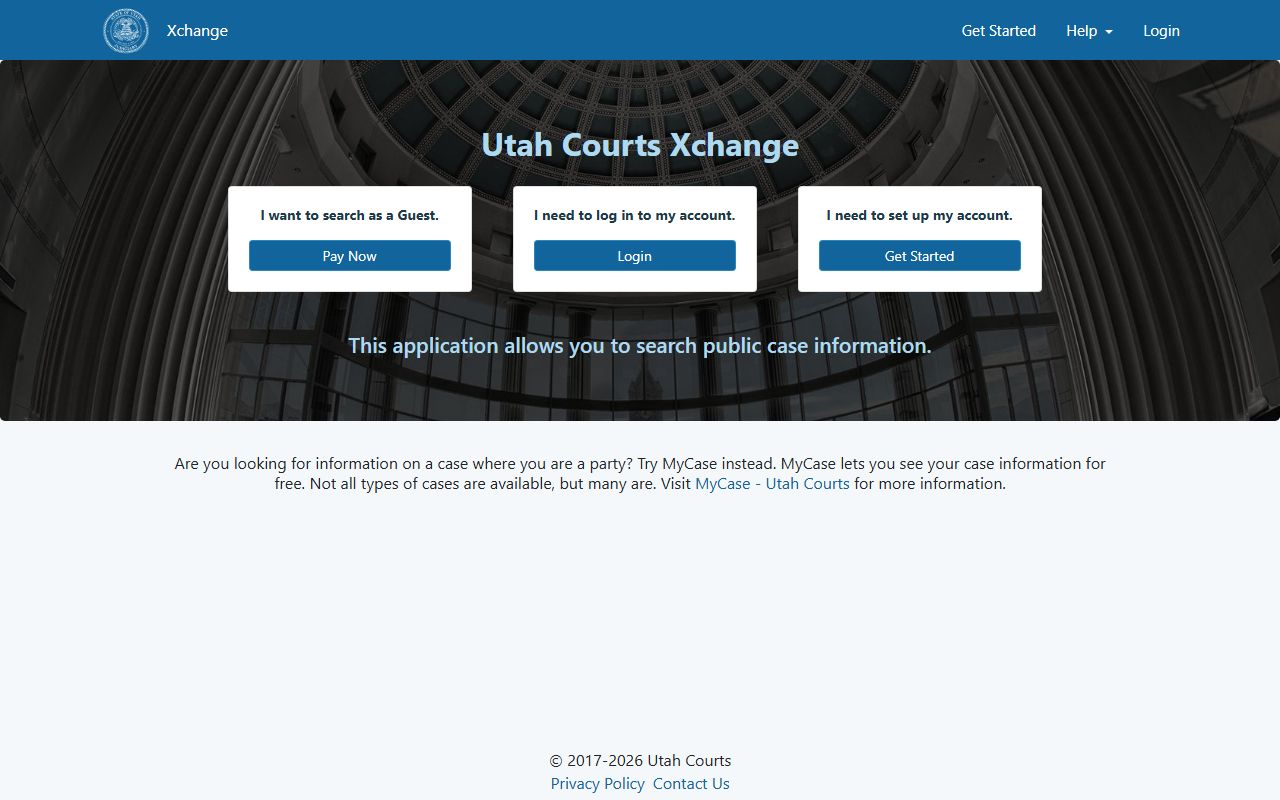
Xchange should be paired with local court contacts when a case is not visible, appears incomplete, or needs certified documents from the clerk.
- Start with any booking date, citation, case number, or charge label from the jail or court paperwork.
- Search Xchange by case number when available, then by defendant name and spelling variants.
- Confirm the court, charge level, hearing dates, warrants, and disposition before relying on a match.
- Use MyCourtCase for personal case access when the case belongs to the person logging in.
- Contact the Morgan clerk if the case is sealed, newly filed, old, juvenile, or not available remotely.
| Search Field or Channel | Type | Required | Notes |
|---|---|---|---|
| Xchange public case search | Web application | Remote account or session may be required | Search Utah court case information by person or case criteria; remote use may involve paid access. |
| MyCourtCase login | Web account | Yes | For a person checking that person's own Utah case history, filings, payments, and linked cases. |
| Courthouse public terminal | In-person terminal | No | Free Xchange access is available at most district courthouses; call ahead for local access details. |
| Case number | Text | No, but best when known | Use the number from a citation, complaint, notice, warrant, or court document. |
| Defendant name | Text | Typical public search path | Use legal name, middle name, spelling variants, and date context before assuming a match. |
Which Morgan Court Handles the Case
Morgan County District Court is part of the Second District Court network. The research identifies Judge Noel S. Hyde, Commissioner Julie Winker, Judicial Assistant Stacy Clark, 2ndmorganteam@utcourts.gov, and 385-350-9170 for district-court matters. District court is the place to expect felony and class A misdemeanor filings. Certified records, file copies, and docket questions belong with the court clerk rather than the jail.
Morgan County Justice Court handles qualifying justice-court matters. County pages identify Judge Brian E. Bower or Brower, Court Clerk Christina Arbogast, christinaa@utcourts.gov, 801-845-4021, and fax 801-825-6008. Payment links and fine information should not be treated as warrant clearance until the court confirms status.
Complaint, Information, and Indictment
A booking record can list a suspected offense, a warrant, a hold, or a bail/fine line, but the criminal court record is built from the charging document filed with the court. The County Attorney screens reports before formal charges are filed or amended. The document may start the case, replace a booking label, or narrow the case after review.
| Document | Who Files It | Common Use | Record Effect |
|---|---|---|---|
| Complaint | Prosecutor or authorized filer | Often begins a criminal case after arrest or citation review. | Creates the filed court allegation and case path. |
| Information | Prosecutor | Common prosecutor-filed document, especially after screening or preliminary stages. | States formal counts, levels, and allegations for court action. |
| Indictment | Grand jury | Less common in ordinary county filings and more associated with serious cases. | Starts or advances prosecution through a grand-jury charging document. |
Charge Status in Court Records
Charges can change after the first booking entry. The prosecutor may file a different charge, amend a count, reduce a level, add a warrant-related allegation, dismiss a count, or resolve the case through plea, trial, or sentencing. A court status should be read count by count because one charge may be dismissed while another remains pending or results in conviction.
| Status | What It Means |
|---|---|
| Filed | The prosecutor has submitted a formal charge to the court. |
| Pending | The charge or case is active and has not reached final disposition. |
| Amended or reduced | The charge, count, degree, or allegation changed after filing. |
| Dismissed | The charge or case ended without conviction on that count. |
| Plea in abeyance | A Utah disposition where a plea may be held under conditions if approved through the court process. |
| Convicted | A guilty plea or finding has entered and sentencing may follow. |
| Warrant issued | The court ordered arrest or appearance enforcement, often after missed court or noncompliance. |
County Attorney and Filing Questions
Morgan County uses the County Attorney title rather than District Attorney. Garrett Smith is listed as Morgan County Attorney, with gsmith@morgancountyutah.gov and 801-845-4080 on the county page. A Utah Prosecution Council listing also gives 48 W Young St, Morgan, UT 84050 and 801-845-4006. L. Dean Saunders is Deputy County Attorney and Morgan Justice Court Prosecutor at dsaunders@co.weber.ut.us and 801-399-8601. Kimberly Payne is Paralegal and Victim Advocate at kpayne@morgancountyutah.gov and 801-845-6093.
The prosecutor decides what, if anything, gets filed after law enforcement creates the arrest report. Victims can use the victim advocate contact and Utah VINELink for notification support. Prosecutor contacts are not substitutes for jail status, legal advice, or consumer background screening.
Bond and O.R. Release After Arrest
Bond information can appear in several places, and each source has limits. Weber roster detail may show public bail/fine entries such as cash or NB, but the court controls many release conditions. Weber says posted-bail releases occur as soon as possible, court releases begin at approximately 5 p.m., and time-served releases begin at approximately 9 a.m. O.R., or own-recognizance release, is court-approved pretrial release based on verifiable ties such as address, employment, and community connections.
Call Weber jail at 801-778-6700 for custody and bail-posting instructions after transport. For Morgan court-controlled bail or fines, call Morgan Justice Court at 801-845-4021 or the district court team at 385-350-9170. Weber warns that it does not call families to say bail can be posted and does not accept Venmo, PayPal, Bitcoin, or similar payment platforms.
Warrants After Missed Court
The Utah Statewide Warrant Search at warrants.utah.gov is the primary official public warrant channel identified in the research. It covers outstanding Utah felony, misdemeanor, and infraction warrants, and searches require first and last name. A single person may have multiple warrants, including warrants from more than one court, so a warrant result should be confirmed with the issuing court before payment, surrender, or travel decisions.
A Morgan warrant may lead to arrest by Morgan deputies, temporary local handling, and transport to Weber or Davis for housing. If the person is booked on a warrant, a roster detail may show fail-to-appear, probation/parole violation, or a bail/fine line without the full court history. Search Xchange for the underlying case and call Morgan Justice Court or District Court to confirm current warrant status, bail, and hearing requirements.
Charges vs. Convictions
An arrest and charge are accusations. A conviction is a final guilty plea or finding. Booking labels, filed charges, and final dispositions can all be different.
| Charge | Conviction | |
|---|---|---|
| Stage | Accusation filed or listed during the case. | Final guilty plea or guilty finding. |
| Source | Roster label, complaint, information, indictment, or amended court count. | Court disposition and sentencing record. |
| Meaning | The case still may be pending, amended, reduced, dismissed, or acquitted. | The court has resolved guilt on that count. |
| Use | Do not describe as proof of guilt. | Still confirm sentence, expungement, appeal, or later order before relying on it. |
GRAMA and Certified Records
Utah GRAMA gives access to public records subject to request procedures, fees, and protected, private, controlled, sealed, juvenile, medical, and law-enforcement-sensitive limits. First identify who holds the record. Morgan Sheriff's Office may hold arrest, incident, transport, or local law-enforcement records. Weber Sheriff's Office likely holds booking, inmate-profile, phone-recording, mugshot-copy, and custody records for people housed at Weber. Court-file copies and certified docket documents should be requested from the court clerk.
Morgan County publishes a general GRAMA request form and lists submit@morgancountyutah.gov as the submission email in the research. Weber accepts online NextRequest or in-person sheriff records requests, requires identity information and photo ID for many sheriff records, and says GRAMA requests must allow a ten-day grace period. Booking photographs have separate Utah restrictions and signed publish-for-pay certification requirements.
Sealed vs. Expunged Records
Utah's expungement framework includes petition eligibility for qualifying arrest, investigation, and detention records. Expungement or sealing is not the same as asking a website or clerk to edit a page. A court order may restrict public access to qualifying records, but eligibility depends on the case result, criminal history, waiting periods, and statutory exclusions. Juvenile, protected, sealed, and expunged records should not be treated like ordinary public adult case records.
| Sealed | Expunged | |
|---|---|---|
| Public visibility | Generally hidden or restricted from routine public access. | Restricted through the Utah expungement process for qualifying records. |
| How it happens | By court rule, order, protected category, or case-specific restriction. | By petition or qualifying statutory process under Utah criminal-record expungement law. |
| Agency records | Some government users may retain limited access where law allows. | Orders may need to be applied across the court and agencies that hold records. |
| Limits | Does not prove the event never occurred. | Does not automatically remove every third-party copy or override every statutory exception. |
Background Check Limits
Casual court searching is not the same as a lawful consumer background check. A person reviewing Morgan County court records after an arrest should verify the originating court, charge status, disposition, and any sealing or expungement order before drawing conclusions.
Important: This private resource is not a consumer reporting agency and must not be used for FCRA-covered decisions.